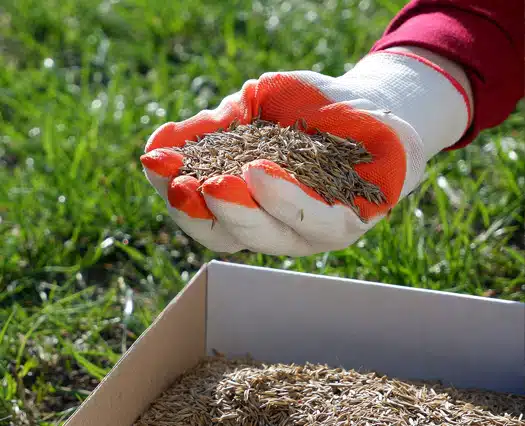
You look at your neighbor’s lush, green lawn and wonder why yours struggles. You water and mow, but the grass stays thin, patchy, or burned out by summer. The problem may not be your effort. It may be your seed. Indianapolis winters are cold. Our summers are humid. Our clay soil is dense. A generic seed from the big box store will not perform here. Choosing the best grass seed for your yard is therefore the foundation of a healthy, resilient lawn.
Tall fescue handles kids, pets, drought, and clay soil with ease. Its deep roots reach moisture other grasses cannot. This allows it to stay green during dry spells. Bouncing back quickly after weekends of play is another strength. Compared to bluegrass, it needs less water and less fertilizer. Modern varieties are finer textured and dark green. For most Indianapolis families, this is the smart choice.
Bluegrass creates that dense, carpet-like lawn everyone admires. Through underground rhizomes, it spreads naturally and fills in thin spots. More water, more fertilizer, and more vigilance against disease are required, however. Without summer water, it goes dormant and brown. Full sun is where it performs best. Bluegrass delivers if you love the look and have time to pamper it. But it asks more of you.
Ryegrass germinates in 5 to 10 days. While rarely planted alone, it provides fast cover as slower grasses establish. Fine fescue, on the other hand, is your shade solution. It thrives under trees where other grasses fail. Foot traffic, however, is not its strength. Quiet, shady spots are where it belongs.
For full sun and low-maintenance durability, choose 100 percent turf-type tall fescue. A bluegrass blend with 10 to 20 percent ryegrass works well for full sun and that classic carpet look. For partial shade, mix 50 percent tall fescue with 50 percent fine fescue. A primarily fine fescue mix is best for heavy shade.
Start by looking for named cultivars like Black Beauty or Falcon IV. Generic blends are best avoided. Checking purity and germination rates is your next step. High quality seed offers 95 percent purity and 85 percent germination. Weed seed content should also be examined. Nothing above 0.5 percent is acceptable. Annual ryegrass is one to avoid entirely. After one season, it dies.
Fall is the absolute winner. Late August through mid-October is your window. Warm soil remains for germination. Cool air reduces stress on seedlings. Weeds, meanwhile, are dying back instead of competing. Strong roots establish before winter dormancy. Spring works but is riskier. Summer is a waste. Patience until fall pays off.
Great seed needs great planting. We use slice seeding for lawns that need real results.
A slice seeding machine cuts shallow furrows into soil. Grass seed drops directly into these grooves. Perfect soil contact. Ideal depth. Fast germination.
Quick germination. Even distribution. Easy maintenance. Your lawn fills in thick that same season.
For new lawns or bare areas, slice seeding beats aeration alone. Aeration takes years to fill in. Slice seeding works now.
Farmer technology for corn, scaled down for your yard. Precise. Efficient. Proven.
Let the pros at Blue Duck Lawn Care take the guesswork out of choosing the best grass seed for your yard. We match the right blend to your sun, soil, and lifestyle. Application happens at the perfect time. We handle the work so you enjoy the results.
Contact Blue Duck Lawn Care today for a free lawn evaluation for Central Indiana. Your lush, green, resilient lawn starts here.
You water, you mow, and you fertilize. Yet your lawn in Fishers or Carmel still…
Nothing spoils the look of your home like a lawn full of unsightly bare spots…
Welcome to your new home in Indianapolis, Carmel, or Fishers! As a first-time homeowner, that…
The moment the frost finally lifts in central Indiana is a welcome one. As a…
If you see a low, sprawling weed with wide blades taking over your lawn each…
Your backyard should be a safe haven for play and relaxation. But when weeds invade,…